
Punjab Kisan Card
Punjab Kisan Card. Under the visionary leadership of Chief Minister Maryam Nawaz Sharif, Punjab’s agriculture sector is witnessing a historic transformation. The introduction of the Kisan Card has changed the way farmers access financial support, agricultural inputs, and modern farming resources. As a result, Punjab is expecting one of its best wheat harvests in recent years, setting new benchmarks for productivity and farmer confidence.
The fertile lands of Punjab have responded positively to this initiative, with farmers cultivating wheat on a record scale. The Kisan Card has emerged as a powerful tool that not only supports farmers financially but also strengthens the overall agricultural economy of the province.
How the Kisan Card Transformed Farming in Punjab
For years, farmers struggled to arrange timely funds for seeds, fertilizers, and other essential inputs. The Kisan Card addressed this long-standing issue by providing easy access to interest-free and subsidized loans, enabling farmers to invest in their crops without financial stress.
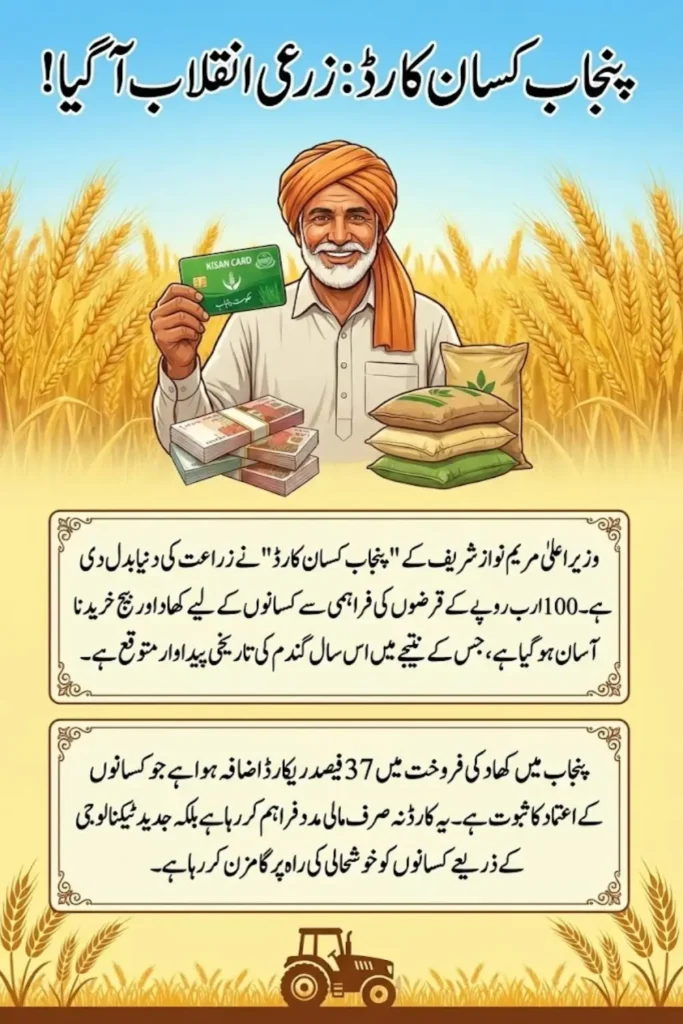
Through this program, Rs 100 billion in loans have been issued to farmers across Punjab. This unprecedented level of financial support has allowed farmers to plan their crops better, purchase quality inputs, and adopt improved farming practices.
Record Wheat Cultivation and Strong Output Expected
Thanks to the availability of funds through the Kisan Card, farmers cultivated wheat on a much larger scale this season. Agricultural experts expect exceptional wheat production, driven by better input usage and timely farming operations.
Farmers were able to buy fertilizers, seeds, and other supplies exactly when needed, which played a crucial role in improving crop health and yield. This timely investment has significantly increased confidence among farming communities.
Historic Increase in Fertilizer Sales
One of the strongest indicators of the program’s success is the massive rise in fertilizer sales. In December alone, approximately 1.356 million metric tons of urea fertilizer were sold, marking a new record for the province.
Compared to last year, Punjab farmers purchased 37 percent more urea fertilizer, showing their increased purchasing power and commitment to higher productivity. This surge reflects how access to financial resources has directly translated into better crop management.
Where the Kisan Card Funds Were Spent
Out of the Rs 100 billion loans issued, farmers have already utilized Rs 65 billion in practical agricultural activities. A significant portion of this amount went toward improving soil fertility and crop nourishment.
- Rs 47 billion was spent on purchasing fertilizers
- Remaining funds were used for seeds, pesticides, and other farm inputs
This spending pattern highlights that farmers are using the funds responsibly and productively to maximize crop output.
Confidence Returns to Punjab’s Farmers
Chief Minister Maryam Nawaz Sharif emphasized that the Kisan Card has done more than provide financial assistance. According to her, the initiative has restored confidence in Punjab’s farmers, empowering them with capital, access to technology, and financial security.
With the Kisan Card in hand, farmers now have:
- Access to timely financing
- Freedom from exploitative lending
- Ability to plan crops with certainty
- Resources to adopt modern farming methods
This renewed confidence is clearly visible in the fields across Punjab.
Technology and Capital Working Together
The Kisan Card is not just a financial tool; it represents a shift toward modern, technology-driven agriculture. Farmers can now track their spending, manage resources efficiently, and make informed decisions about crop inputs.
By combining capital with technology, the Punjab government has laid the foundation for a more resilient and productive agricultural sector.
Agriculture as the Backbone of Pakistan’s Economy
Chief Minister Maryam Nawaz Sharif reiterated that Pakistan’s development is directly linked to the prosperity of its farmers. Agriculture remains the backbone of the national economy, and strengthening this sector is essential for food security, employment, and economic stability.
She stated that when farmers grow, the entire country benefits — from reduced food prices to increased exports and rural development.
A Model for Sustainable Agricultural Growth
The success of the Kisan Card program is being seen as a model for sustainable agricultural growth. By ensuring that farmers have access to affordable financing and essential inputs, the government has created a system that supports long-term productivity rather than short-term relief.
This approach not only boosts crop yields but also encourages responsible farming practices and financial discipline.
Conclusion
The Punjab Kisan Card has proven to be a game-changer for agriculture. With Rs 100 billion in loans issued, record fertilizer sales, and expectations of outstanding wheat production, the program has delivered real results on the ground.
Under the leadership of Chief Minister Maryam Nawaz Sharif, Punjab’s farmers now have confidence, capital, and the tools they need to succeed. The transformation seen in the fields today is a strong sign that empowering farmers is the key to Pakistan’s agricultural and economic future.
Canada Permanent Residence for Pakistan 2026: Express Entry Federal Skilled Worker Program Guide